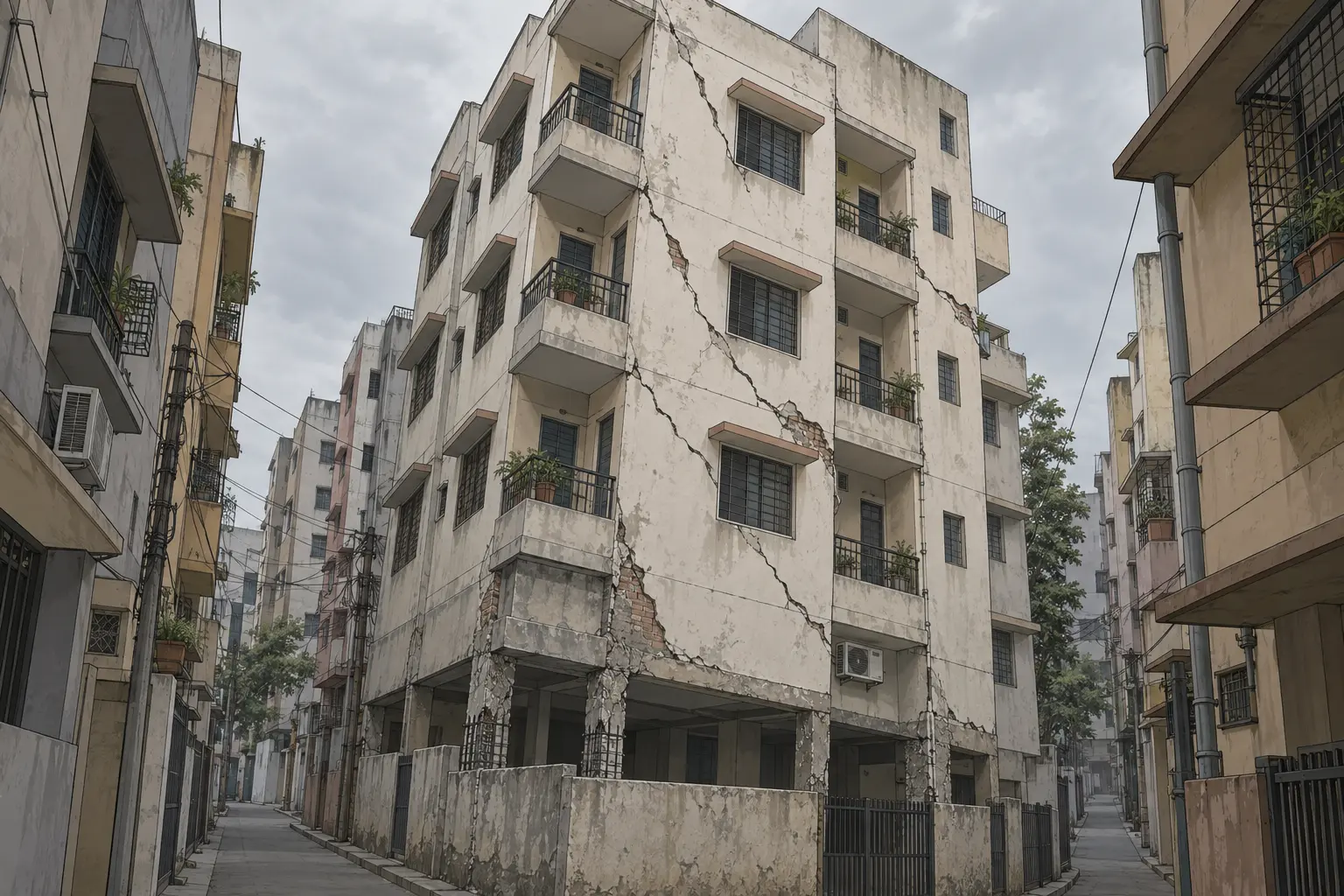
On the afternoon of 6 September 2026, a five-storey building in Satya Niketan, South Delhi collapsed. The building had been operating as a paying guest accommodation for students attending nearby Delhi University colleges. An estimated 40 to 50 people were inside when it came down. Seven of them died. Five more were critical. Student volunteers arrived before the NDRF and pulled people from the rubble with their bare hands.
The structural conditions that produced this collapse are not unusual. They are common. And the question of whether they exist in your building is one worth asking now, not after.
What the Satya Niketan Collapse Reveals About Building Safety
The structure was approximately 40 years old, originally sanctioned as a low-density residential property. Over the years it had been converted into commercial student accommodation, with 15 rooms housing two to three students each. According to police investigations, a load-bearing wall was allegedly removed during basement renovation work that was underway without structural authorisation at the time of the collapse.
The building had reportedly been flagged for safety concerns and vacated once before being returned to use. In the aftermath, the MCD suspended five municipal officials for negligence in oversight, and the owner was arrested and charged with culpable homicide not amounting to murder.
Investigators characterised the failure as a pancake collapse — each floor falling onto the one below it in sequence. This is what happens when a structure loses a critical load path: the load redistributes instantly, and if what remains cannot absorb it, progressive failure follows within seconds.
The Satya Niketan collapse highlights the consequences of compromised structural systems. It also raises a broader question for older buildings: whether the foundations and supporting ground remain capable of carrying the loads they are now expected to support.
A missing load-bearing wall, an unauthorised structural alteration, and weak or deteriorated ground are not the same failure mechanism. But each can affect a building's ability to safely transfer and carry loads. Understanding which condition exists is the first step toward determining the right remediation approach.
The lesson is not that every older building is unsafe, or that every structural problem originates in the foundation. It is that a building's safety depends on the condition of the entire load-bearing system — including the ground and foundation beneath it.
Why Foundation Stability Is the Core of Structural Safety
A building's structural system ultimately transfers its loads into the ground through its foundation. That makes the condition of the supporting soil and the stability of the foundation critical to the performance of the structure above it.
When the ground beneath a foundation weakens, settles unevenly, loses bearing capacity, or develops voids, the foundation may no longer perform as intended. The resulting movement can place additional stress on structural elements, affect floor levels, and contribute to cracking or other signs of distress.
This is why a building can appear sound on the surface while still having a problem beneath it. The condition of the supporting ground is not always visible, and foundation distress may develop gradually rather than through a single dramatic event.
How Aging Buildings Develop Foundation and Ground Problems
The Satya Niketan building was 40 years old. Many buildings of that age in Delhi and other Indian cities were designed under standards that assumed a fixed use — a family home, a small commercial space — and a fixed load. What has changed since is everything else.
Additional floors have been added without structural calculation. Internal walls — some load-bearing — have been removed to create larger commercial spaces. Basements have been excavated after the superstructure was already in place. Decades of water seepage have degraded mortar, corroded reinforcement, and softened the soil beneath the foundation. Through all of this, the original foundation, designed for a different structure carrying different loads, has been asked to hold.
In some cases, the issue is not simply the age of the foundation itself, but the condition of the ground supporting it. Changes in drainage, prolonged water ingress, excavation, or altered loading can affect the soil beneath an existing structure.
Where settlement is uneven, the concern is not merely that a building has "sunk." It is that different parts of the structure may be moving differently, creating stresses that the original design was not intended to accommodate.
What Foundation Distress Can Mean for an Existing Structure
Not every crack, uneven floor, or instance of settlement indicates an imminent structural failure. But these signs should not be dismissed without understanding their cause. The conditions that warrant proper investigation include:
- Differential settlement, where different parts of a building settle by different amounts
- Weak or loose supporting soil, which may not provide adequate bearing support
- Voids beneath slabs or foundations, reducing the contact and support available to the structure
- Water ingress and soil softening, which can alter ground conditions over time
- Changes in loading or building use, which may place demands on the foundation that differ from the original design assumptions
- Excavation or construction near existing foundations, which can affect the surrounding ground and its ability to support the structure
The important question is not simply whether a building is old. It is whether its foundation and supporting ground remain suitable for the loads and conditions it is experiencing today.
What a Responsible Building Owner Can Do
The MCD has issued city-wide sealing orders for unauthorised structures exceeding four storeys following the Satya Niketan collapse, and self-demolition notices have gone to adjacent properties in the area. These are necessary measures, and they are overdue.
For building owners and facility managers, the more immediate question is what can be done without waiting for enforcement. The starting point is a structural assessment by a qualified civil or structural engineer — a formal evaluation of the load-bearing elements, the foundation condition, and the history of any alterations made since the original structure was built.
Where foundation distress is identified, the next step is to establish its cause and extent. Is the issue related to the structural system, the supporting soil, water ingress, settlement, or a combination of factors? The answer determines which remediation options are appropriate.
Where Soil Injection Technology Can Help
Where foundation distress is linked to weak or inadequate ground support, targeted soil injection can be one of the remediation approaches considered after proper assessment.
Depending on the site conditions and the injection technology used, soil injection can help improve the ground supporting an existing structure. It may be used to densify or strengthen suitable soils, fill voids beneath slabs or foundations, and improve load transfer into the ground.
For certain applications, this can provide a way to address ground-related foundation distress without relying entirely on extensive excavation or prolonged operational shutdown.
However, soil injection is not a universal solution for every structural problem. It does not replace the need to repair damaged structural elements, restore missing load-bearing components, or correct unsafe alterations. Its suitability depends on the actual cause of the distress, the ground conditions, and the requirements of the structure. That is why assessment must come before intervention.
Can Foundation Distress Be Remediated Without Demolition?
Where the underlying issue is related to ground support, remediation options may exist that do not require demolition or prolonged operational shutdown.
In suitable cases, targeted soil injection can help address settlement, voiding, or inadequate ground support while allowing much of the existing structure to remain in place. The objective is not simply to treat a symptom, but to improve the ground conditions that are contributing to the distress.
The appropriate approach depends on the site investigation, the foundation type, the soil profile, the extent of movement, and whether the structure above has also been damaged. The key is to identify the problem correctly before selecting the technology.
What Building Owners Should Do When Foundation Distress Is Suspected
For building owners and facility managers, the immediate question is what can be done without waiting for a visible failure. The starting point is a structural and, where required, geotechnical assessment by qualified professionals. This should consider:
- The condition of the load-bearing elements
- The foundation type and condition
- The supporting soil and ground conditions
- Any history of settlement, water ingress, or cracking
- Changes in building use, loading, or layout
- Any excavation, extension, or alteration carried out since construction
Once the cause is understood, the owner can evaluate whether the appropriate response is structural repair, foundation strengthening, ground improvement, soil injection, or another remediation method. For older buildings that have been repurposed, extended, or had basement work carried out, this is not an optional exercise.
The Lesson for Older Buildings Across India
Satya Niketan is a residential neighbourhood. But the same questions about foundation stability apply equally to older industrial facilities, factory buildings, warehouses, and logistics parks that have been modified or extended over time.
A building that appears sound on the surface may have a sub-base or foundation condition that has changed materially. Changes in use, loading, drainage, excavation, and surrounding ground conditions can all affect how an existing foundation performs.
The lesson is not that every older building requires intervention. It is that foundation stability should be assessed rather than assumed, particularly when a building has undergone significant changes or shows signs of distress. Where ground-related foundation problems are identified, soil injection technology may offer a targeted remediation option — provided the site conditions and the nature of the problem make it suitable.
The only way to know is to look.