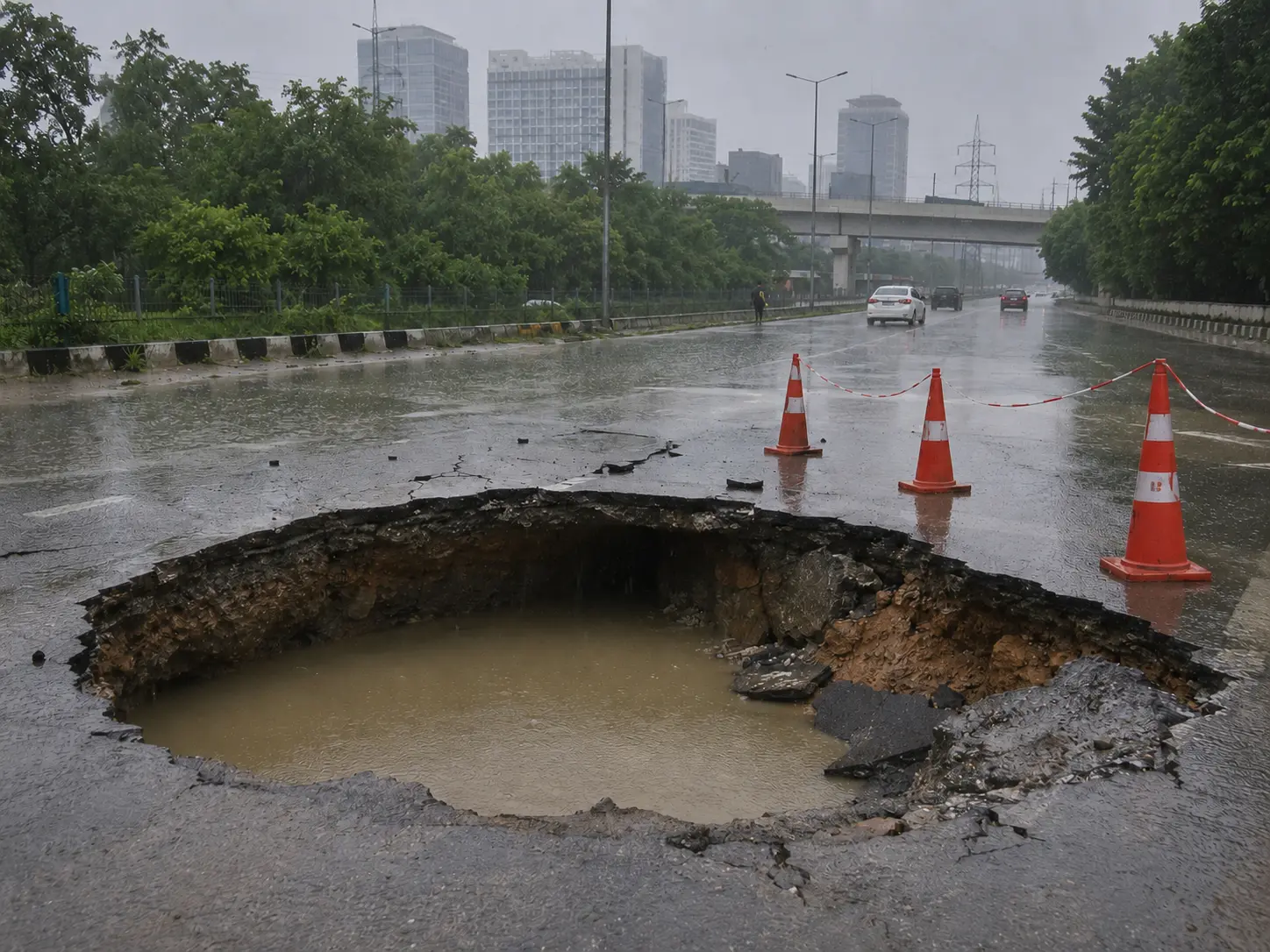
The images went viral within hours. A section of the service lane on NH-48 at IFFCO Chowk in Gurugram had simply disappeared — a large pit where the road surface had been, heavy vehicle tyres caught at its edge, green safety netting strung around the perimeter. It happened on 25 August 2026, during a monsoon spell that dropped 70 millimetres of rain in 35 minutes. Schools had gone online. Offices had sent people home. And then, the ground gave way.
The preliminary investigation confirmed the cause: a GMDA sewer line had been leaking beneath the road. Over time, that leak had been slowly washing fine soil particles away from underneath the bituminous surface. The void grew. The surface held — until it didn't. When the monsoon arrived and saturated what remained of the sub-base, there was nothing left to support the road above. The collapse, when it came, took seconds.
It was not the only cave-in in Gurugram that day. Two other roads failed at the same time, for the same underlying reason.
Why Bituminous Roads Cave In — and Concrete Floors Do Not
The IFFCO Chowk failure was visible and dramatic because the road surface was bituminous — flexible, relatively thin, and unable to bridge a growing void once the support beneath it was gone. The moment the sub-base gave way, the surface followed.
Concrete behaves differently. A reinforced concrete slab — the kind that forms the floor of a factory, warehouse, port terminal, or logistics park — has enough structural rigidity to span a developing void for months, sometimes years, before anything appears at the surface. This is not a comfort. It is a warning.
The same mechanism that brought down the road at IFFCO Chowk is operating, right now, beneath concrete floors across India's industrial estates — silently, and without the visible warning signs that a bituminous surface provides.Any facility with underground infrastructure running beneath its floor is exposed to this risk. Fire suppression lines, sewage drainage, process water pipes, stormwater channels — if any of these develop a slow leak, the water does not simply drain away. It carries soil particles with it. Over months and monsoon cycles, the material that was compacted beneath the floor during construction gradually migrates, leaving voids that the slab above is now bridging instead of resting on.
What the Warning Signs Actually Look Like
At IFFCO Chowk, the warning sign was the collapse itself. There was no gradual visible deterioration — the bituminous surface gave way all at once. This pattern is not new to GMDA and NHAI. As far back as December 2023, GMDA had formally written to NHAI warning that ageing pipelines beneath the IFFCO flyover retaining wall posed a collapse risk — a warning that anticipated almost exactly what happened two and a half years later.
In an industrial facility, the warning signs are slower and quieter. A joint between two slab sections develops a small lip — one side sits fractionally lower than the other. A diagonal crack appears near a column base. A section of floor that used to feel solid now has a faint flex to it when a loaded forklift crosses. These are not cosmetic problems. They are a concrete slab communicating that the ground beneath it has changed.
What Can Actually Be Done
The IFFCO Chowk situation required excavation and reconstruction. The damage was too extensive, and a bituminous road does not lend itself to targeted sub-surface intervention. That work will take weeks and cause significant disruption on one of Gurugram's most congested stretches.
For industrial facilities, the situation is often different — precisely because a concrete slab is still structurally intact when the problem is caught early. Where a void has formed beneath a factory or warehouse floor due to a leaking pipe or drainage failure, expanding geotechnical polymer injected through small holes in the slab can fill that void and re-establish support — without breaking out the floor, without shutting the facility, and without weeks of cure time.
Two caveats are worth being clear about. If a pipe is still actively leaking, that must be fixed first — treating the void while the source of erosion continues is not a solution. And if the slab itself has fractured through its full depth, more extensive work is needed regardless.
But for subsidence caught before catastrophic failure — which is most cases in industrial facilities, where concrete buys time that bituminous road surface does not — targeted injection addresses the void that created the problem, not just the surface above it.
The IFFCO Chowk road will be repaired and will reopen. What is harder to know, without looking, is how many industrial floors across Delhi NCR are developing the same condition right now — quietly, beneath a concrete surface that, for the moment, is still holding.
If your facility has underground pipework and you have noticed any unevenness, cracking, or joint movement in the floor over the last 12 months, this monsoon season is the right time to have it looked at.