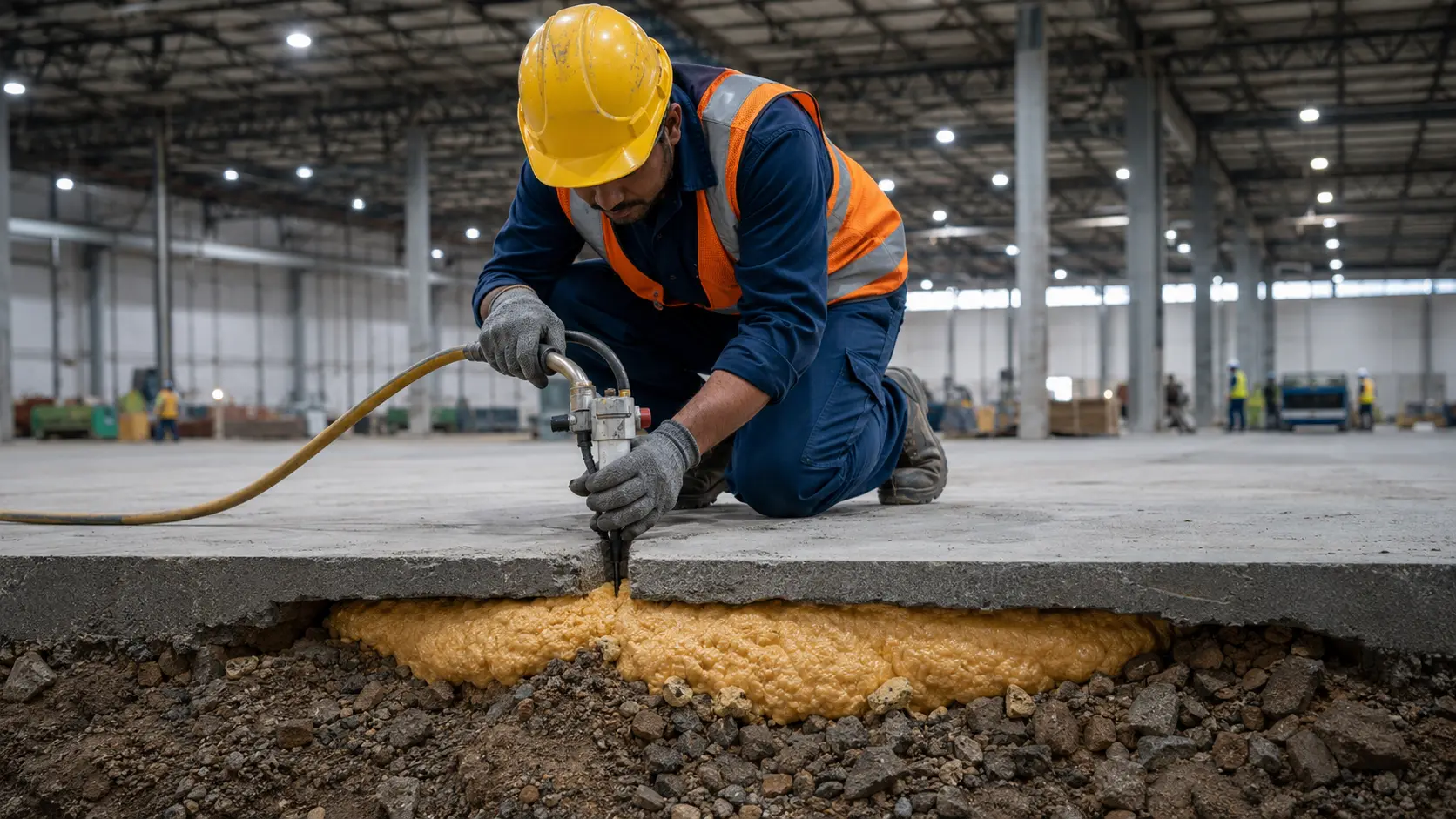
When an industrial floor settles or develops structural cracks, two broad options are usually on the table: replace the slab or inject beneath it. Both can work. But they are not interchangeable, and choosing the wrong method — or defaulting to the more familiar one — can mean spending more, waiting longer, and still not solving the underlying problem.
What slab replacement actually involves
Slab replacement is exactly what it sounds like. The settled or damaged concrete is broken out, the sub-base is excavated and re-compacted, new reinforcement is laid, and fresh concrete is poured. Once the concrete has cured — typically 28 days for full structural strength — the floor is returned to use.
In a factory or warehouse, this means a minimum of four to six weeks of full operational shutdown for the affected zone. If the facility is a manufacturing operation with continuous production, the cost of that shutdown may be multiples of the repair cost itself.
What polymer injection involves instead
Polymer injection addresses the same problem — a settled, weak, or voided floor — from beneath rather than above. Two-component expanding polyurethane resin is injected through 16mm ports drilled through the existing slab. The resin flows into voids in its liquid state, then expands to fill them and densify the surrounding soil. As it does so, it exerts upward pressure that lifts the slab back to its original level.
The slab itself is never removed. The existing reinforcement is preserved. The facility can typically resume operations within hours of injection completing, rather than weeks.
The cost comparison that changes minds
On a direct material and labour basis, polymer injection and slab replacement often cost roughly the same for the same area of floor. What changes the comparison is operational downtime. Consider a facility turning over ₹50 lakh per day: even a conservative estimate of two weeks' shutdown adds ₹7 crore in lost production to the apparent cost of slab replacement.
- Timeline to full use: Polymer injection: hours. Slab replacement: 4–6 weeks minimum.
- Disruption: Polymer injection: targeted ports, minimal debris. Slab replacement: full demolition and excavation.
- Sub-base treatment: Polymer injection fills voids and consolidates loose material. Slab replacement re-compacts the immediate sub-base but may not reach deeper weak zones.
- Structural life: Both methods, when correctly executed, offer a similar design life.
When slab replacement is the right answer
Polymer injection is not always the better option. There are situations where slab replacement is genuinely necessary:
- Where the concrete slab has sustained physical damage — severe cracking or delamination — that cannot be remediated from beneath.
- Where chemical contamination has degraded the slab itself.
- Where a major redesign of the floor is planned and the existing slab needs to come out regardless.
The right starting point for either option is a proper investigation: ground penetrating radar to map voids, dynamic load testing to profile sub-base strength, and a structural assessment of the slab itself.
GeoLift carries out investigations before recommending any approach. Where slab replacement is genuinely the right answer, we say so. Where polymer injection will resolve the problem faster and at lower total cost, we demonstrate why — with the ground data to support it.